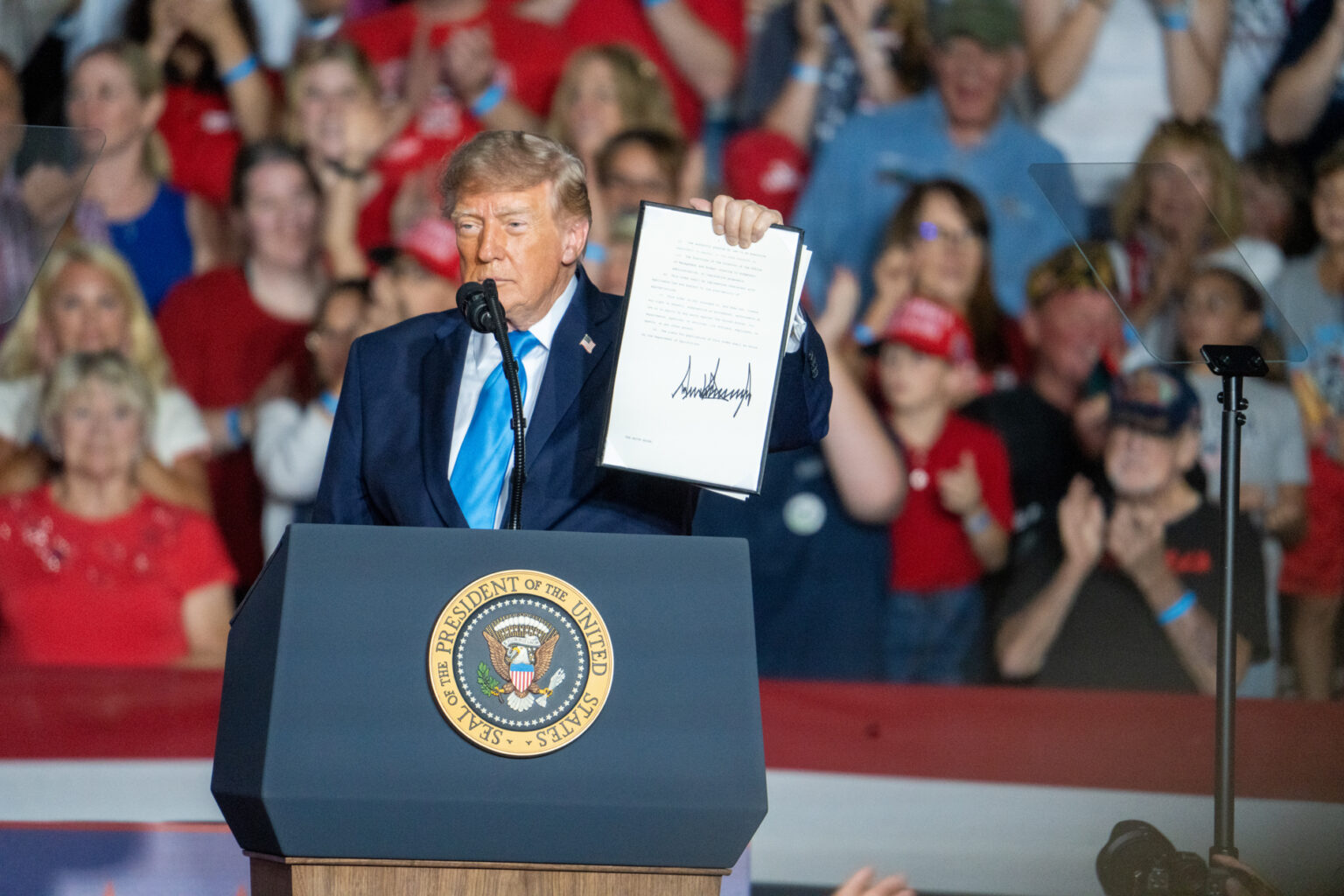
President Donald Trump signed an executive order Monday during a campaign rally in Grand Island, Nebraska, temporarily expanding access to red-dyed diesel and easing federal tax enforcement for highway use of the fuel.
The order is designed to provide temporary relief to farmers, truckers and other diesel users as fuel prices remain elevated. Trump signed the order on stage before a crowd while campaigning ahead of the November 3 midterm elections.
The White House described the action as an effort to reduce diesel costs by allowing greater use of fuel that is normally reserved for tax-exempt off-road purposes.
What Is Red-Dyed Diesel?
Red-dyed diesel is essentially the same type of diesel fuel used in many highway vehicles, but it contains a red dye that allows authorities to identify fuel that has been sold for tax-exempt purposes.
Under normal federal rules, diesel intended for uses such as agriculture, construction and certain other off-road activities is exempt from the federal highway fuel tax. The dye helps enforcement officials distinguish that fuel from diesel intended for on-road use.
The federal diesel tax is currently 24.4 cents per gallon.
Trump’s order temporarily changes how that tax requirement is enforced for qualifying use of dyed diesel on highways.
What Trump’s Executive Order Actually Does
The executive order directs the Treasury Department to determine whether the government can defer certain diesel tax obligations under existing federal law.
If authorized, taxes incurred between October 5 and December 31, 2026, can be deferred without interest or penalties.
The order also directs the IRS not to impose certain penalties for the use of dyed diesel on highways during that period, subject to the legal authority available to the administration.
This means the action is temporary, rather than a permanent repeal of the federal diesel tax.
The order also instructs the administration to explore possible ways, including legislation, to eliminate the obligation to pay the deferred taxes.
Trump Says the Move Will Lower Costs
Trump presented the measure as another step aimed at reducing fuel costs for Americans who depend on diesel.
During the Nebraska rally, he said the typical truck driver could save more than $100 per fill-up and argued that lower transportation costs could eventually reduce the price of goods.
The White House has similarly promoted the order as a way to help farmers and truckers facing elevated diesel prices.
However, the actual savings will depend on factors including fuel availability, state policies and whether individual users have access to dyed diesel.
Farmers Already Use Red-Dyed Diesel
One important distinction is that farmers and other traditional off-road users already benefit from tax-exempt dyed diesel in many circumstances.
As a result, the biggest potential change is for on-road users, including truckers and agricultural operators who need to use diesel-powered vehicles on public roads.
GasBuddy petroleum analyst Patrick De Haan has questioned how much the policy will reduce overall fuel costs, arguing that current diesel pressures are more closely connected to supply than taxes.
States Still Have a Role
The federal executive order does not automatically override every state fuel-tax rule.
The White House has instructed officials to encourage states to adopt corresponding policies, while the order itself operates within the limits of existing federal law.
Nebraska, for example, has already provided guidance explaining how the federal action interacts with state rules.
The Nebraska Department of Revenue says Trump’s federal order clears the way for temporary highway use of dyed diesel and deferral of the applicable federal excise tax, while state-level requirements and enforcement can still matter.
That means drivers and businesses should not assume that the federal order automatically eliminates every state tax or penalty.
Why the Order Comes Now
The announcement comes as diesel prices have risen sharply amid disruptions in global energy markets.
The administration has pointed to restricted global diesel supply and international conflicts as factors contributing to higher prices. Reuters and other outlets have reported that the administration is also considering additional measures to address diesel and heating-fuel costs.
The timing is also politically significant because Trump is conducting an intensive campaign schedule ahead of the November midterms.
His Nebraska appearance included support for Republican Sen. Pete Ricketts and Gov. Jim Pillen, making the fuel announcement part of a broader political event focused on economic concerns.
How Much Could Drivers Save?
The potential savings vary depending on fuel consumption and whether a driver can actually obtain dyed diesel.
The White House estimates that the federal diesel tax amounts to 24.4 cents per gallon, meaning a 250-gallon fill could represent roughly $61 in federal tax before considering state taxes.
Where state governments adopt similar relief, total savings could be higher.
The administration has also said it wants to improve the availability of dyed diesel in areas where demand is high.
A Temporary Measure, Not a Permanent Tax Cut
Despite Trump’s description of the action as a major step to reduce diesel costs, the executive order itself establishes a temporary framework.
The current relief period runs through December 31, 2026, while the administration explores whether the deferred federal tax obligations could eventually be eliminated through additional action, including legislation.
Congress would therefore have a role if the administration ultimately seeks a permanent change to federal diesel-tax requirements.
What Happens Next?
Federal agencies are expected to issue additional guidance explaining exactly who qualifies for the relief, how the deferred taxes will be handled and what conditions apply.
The Treasury Department and IRS will determine the specific implementation of the tax deferral and penalty relief, while the Agriculture and Transportation departments will work with states and industry groups on access and implementation.
For farmers, truckers and other diesel users, the practical question will be whether the temporary policy translates into meaningful savings at the pump.
For now, Trump’s executive order provides temporary federal relief for highway use of dyed diesel, but it does not permanently eliminate the federal diesel tax or permanently abolish the distinction between on-road and off-road fuel.