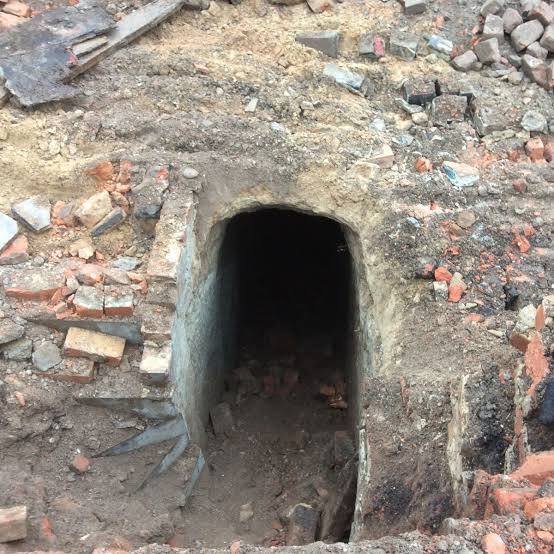
Beneath the streets of Washington, D.C., near one of America’s most recognizable museum buildings, construction workers uncovered a hidden brick chamber that had remained out of sight for more than a century.
The discovery sounded like the beginning of a historical mystery. Was it an underground room? A forgotten passageway? A secret storage space left behind by generations of museum staff?
The truth was less dramatic—but far more revealing about how people lived and built in the 19th century.
The chamber was a cistern designed to collect rainwater. Discovered during work connected to the Smithsonian Castle’s major renovation in August 2024, the structure offered a glimpse into an early water system that had largely disappeared from institutional memory.
And its story reaches back to the very beginnings of the Smithsonian Institution.
A Hidden Structure Beneath Washington’s National Mall
The discovery happened near the Smithsonian Institution Building, widely known as the Castle because of its distinctive medieval-inspired architecture.
Construction crews were working beneath Jefferson Drive, the road running alongside the Castle and other museums on the National Mall, when they found the opening to the underground structure.
According to the Smithsonian’s architectural preservation team, the chamber was located approximately four and a half feet beneath the road surface and about 45 feet east of the Castle’s north entrance area.
Its dimensions were striking for a structure that had remained hidden. The circular brick chamber measured approximately nine feet across and reached about 30 feet deep.
Yet the most interesting detail was not its size. It was what the structure had been built to do.
The chamber was a rainwater cistern, an underground reservoir intended to collect and hold water. When workers uncovered it, the structure was dry and empty.
There were no reported treasures or mysterious artifacts waiting inside. Instead, the discovery revealed an overlooked piece of practical engineering from Washington’s early history.
Why Did the Smithsonian Need an Underground Cistern?
To understand the chamber, it helps to look at the Smithsonian Castle’s beginnings.
The Smithsonian Institution was established by Congress in 1846, following a bequest from British scientist James Smithson, who had directed that his fortune be used to support the advancement of knowledge.
The institution needed a headquarters, and construction of its first building began in the late 1840s. Designed by architect James Renwick Jr., the Castle was completed in 1855.
At the time, the building served many purposes. It housed administrative offices, exhibition areas, a library, laboratories, storage spaces and living quarters for the institution’s first secretary, Joseph Henry, and his family.
Providing water for a building with so many functions was an important practical challenge.
The Smithsonian’s architectural historians explain that three in-ground cisterns were constructed around the Castle in approximately 1847. They collected overflow from rainwater cisterns located within the roofs of the building’s east and west wings.
In other words, the Castle had a water-collection system long before modern plumbing infrastructure became standard.
Rainwater could be gathered and stored instead of simply running off the roof and disappearing into the surrounding ground. The system formed part of a broader effort to make the building relatively self-sufficient in water and wastewater management.
According to the Smithsonian’s preservation research, the building’s original arrangements even served interior bathrooms.
That makes the newly uncovered chamber more than an isolated curiosity. It is evidence of how the institution approached basic infrastructure when its first headquarters was being established.
A System That Eventually Disappeared From Memory
The cistern did not remain central to the Castle’s operations forever.
In 1865, the building was connected to Washington’s public water system. That change reduced the need for the original rainwater infrastructure.
As the city and the Smithsonian grew, buildings were modified, utilities changed and older systems became less important to everyday operations.
Over time, knowledge of the underground cistern’s exact location was lost.
The Smithsonian’s architectural preservation team has documented three original cisterns. One had already been discovered in 1974, then filled in. The locations of other structures were not fully known.
The 2024 discovery therefore helped researchers reconnect the surviving physical evidence with the Castle’s early construction history.
It also demonstrates a familiar challenge in historic preservation: records can become incomplete, and structures that once served essential purposes can disappear from institutional memory even when they remain physically intact.
A forgotten water reservoir might not seem as exciting as a lost vault filled with valuables. But for historians and preservation specialists, knowing how a landmark functioned is an important part of understanding its past.
The Castle Has Its Own Remarkable History
The underground chamber is only one piece of the Smithsonian Castle’s long story.
Built from red sandstone quarried near Seneca Creek in Maryland, the building became a recognizable feature of Washington’s National Mall. Its architectural design combined elements associated with medieval Romanesque and Gothic styles.
It also survived a major disaster.
On January 24, 1865, a fire severely damaged portions of the Castle, destroying the upper story of the main section and affecting its towers. Reconstruction followed, and the building continued to evolve as the Smithsonian expanded.
Over the decades, its rooms and systems changed to accommodate new needs. The original headquarters of a growing scientific and cultural institution gradually took on different administrative and visitor-facing roles.
The building later underwent multiple renovations, including a major restoration in the 1960s. In 2023, it closed for another extensive revitalization project intended to modernize its infrastructure while restoring historic features.
Work associated with that project created an opportunity to examine areas around the Castle that had not been fully understood for generations.
The cistern discovery is a reminder that even familiar landmarks can hold details that historians have yet to document completely.
Does the Discovery Prove There Is a Secret Underground City?
Stories about hidden spaces beneath Washington have circulated for years, including claims about enormous underground networks and mysterious facilities beneath the National Mall.
The existence of the cistern, however, does not prove those claims.
The Smithsonian has addressed myths about supposed underground storage complexes beneath the Mall. While real staff-only passageways and tunnels connect certain institutional buildings, the existence of those limited spaces should not be confused with stories about a vast secret city or hidden museum filled with undisclosed treasures.
The cistern has a documented explanation: it was part of a 19th-century rainwater collection system.
That distinction matters. An authentic discovery can be fascinating without requiring an unsupported conspiracy theory to make it interesting.
In fact, the verified story offers something more useful: a tangible connection to the engineering decisions, daily needs and changing technology of an earlier era.
Why Forgotten Places Matter
Historic discoveries do not always transform what we know about the past. Sometimes they fill in a missing detail.
The underground cistern near the Smithsonian Castle is a good example. It did not reveal a lost treasure, but it helped researchers better understand how one of the country’s most important cultural institutions managed water during its earliest years.
It also shows why restoration work can uncover more than damaged stonework or outdated pipes. Digging into a historic site’s infrastructure can reveal the practical systems that made the building function in the first place.
For visitors, the Castle is an architectural landmark. For historians, it is a record of changing ideas, technologies and institutional priorities. Beneath the surrounding streets, the forgotten cistern adds another layer to that record.
The chamber’s discovery may not solve a grand mystery, but it answers a genuine historical question: how did the Smithsonian manage water before modern public infrastructure became available?
Sometimes, the most interesting secrets of the past are not secrets at all. They are ordinary solutions whose stories were simply forgotten.
Sources: Smithsonian Institution, Architectural History and Historic Preservation, “Discovering a Castle Cistern”; Smithsonian Magazine, “Workers Uncover an Underground Chamber Sealed for More Than a Century Near the National Mall.”