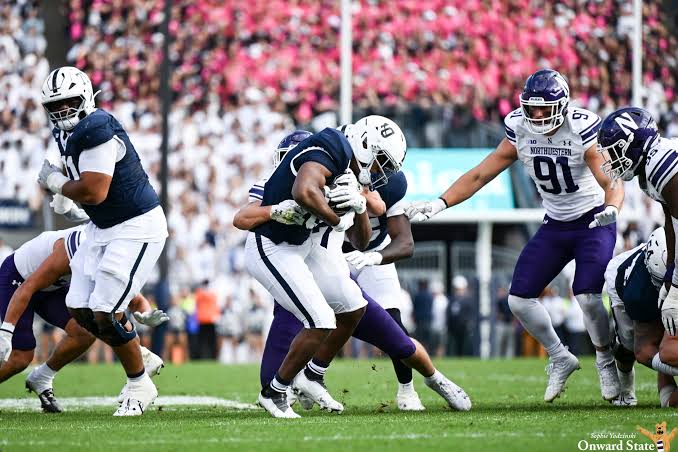
Penn State’s difficult start to the Matt Campbell era took another major turn Friday night.
The Nittany Lions were dominated by Northwestern, falling 34-13 in the first football game at the Wildcats’ new Ryan Field. The defeat dropped Penn State to 3-2 overall and 0-2 in Big Ten play, marking the program’s second straight loss after blowing a 17-point lead against Wisconsin the previous week.
For a program entering the season with major expectations, the performance raised questions far beyond one bad night. Penn State struggled to stop the run, struggled to sustain offense and repeatedly failed to capitalize on opportunities.
Here are five major takeaways from the loss.
1. Penn State’s Run Defense Was Completely Overwhelmed
The biggest story of the night was Northwestern’s rushing attack.
The Wildcats ran for 413 yards, averaging more than seven yards per attempt, while Caleb Komolafe and Joseph Himon II both surpassed 100 rushing yards.
Komolafe finished with 188 yards and a touchdown on 25 carries, while Himon exploded for 162 yards and two touchdowns on just 10 carries.
Northwestern repeatedly found enormous running lanes, turning what was expected to be a competitive Big Ten matchup into a one-sided physical battle. The Wildcats finished with 506 total yards, while Penn State managed only 291.
The defensive collapse was particularly concerning because Penn State had allowed only 113.2 rushing yards per game through its first four games, according to Sports Illustrated’s postgame analysis.
This was not simply a case of giving up one or two explosive plays. Northwestern consistently controlled the line of scrimmage.
2. Rocco Becht’s Experience Wasn’t Enough
Quarterback Rocco Becht entered the season with considerable experience, but Friday night exposed some of the limitations in Penn State’s passing game.
Becht completed 26 of 41 passes for 243 yards and one touchdown, but he also threw two interceptions. Penn State’s offense repeatedly struggled to create sustained drives, while Northwestern’s defense kept the Nittany Lions from generating enough explosive plays to keep pace.
The bigger concern was consistency.
Penn State finished with only 48 rushing yards, meaning the offense couldn’t establish a dependable ground game to take pressure off Becht.
That created an increasingly difficult situation as Northwestern built its lead.
3. Conservative Decisions Are Going to Get Scrutinized
Another major storyline coming out of the game is Penn State’s fourth-down decision-making.
The Nittany Lions punted on fourth-and-5 from Northwestern’s 44-yard line during the opening drive. Later, Penn State punted on fourth-and-2 from its own 44.
In the second half, Penn State again chose to punt on fourth-and-10 from the Northwestern 43 despite trailing heavily.
Sports Illustrated also highlighted the decision not to attempt an onside kick after Penn State scored with 7:53 remaining and still faced an 18-point deficit.
None of those decisions alone explains a 21-point loss, and more aggressive calls would not necessarily have changed the outcome.
But after a second consecutive defeat, Campbell’s game-management philosophy is likely to receive significant attention.
4. The Offense Has Become a Bigger Concern
Penn State’s offensive struggles were already visible during the loss to Wisconsin.
Against Northwestern, they became even harder to ignore.
The Nittany Lions scored only 13 points, managed just 48 rushing yards and went through a lengthy scoring drought before Becht connected with Chase Sowell for a 16-yard touchdown in the fourth quarter.
Sowell finished as Penn State’s leading receiver by yardage, recording five catches for 68 yards and the touchdown. Carson Hansen provided Penn State’s other touchdown with an 8-yard rushing score.
Meanwhile, Northwestern had already built a 24-7 halftime advantage.
The Wildcats outgained Penn State 278-139 in the first half, including a staggering 237-26 advantage on the ground.
That kind of first-half imbalance made a comeback extremely difficult.
5. The Pressure on Campbell Has Arrived Much Earlier Than Expected
Campbell’s first season at Penn State was always going to come with enormous expectations.
But the Nittany Lions are now 3-2 overall and 0-2 in the Big Ten, with consecutive losses to Wisconsin and Northwestern.
The Northwestern defeat is especially damaging because it exposed problems in multiple areas at the same time: run defense, offensive consistency, quarterback play, situational decisions and overall physicality.
That does not by itself determine Campbell’s future, but it explains why scrutiny around the program has intensified.
Penn State now has little time to regroup.
Penn State’s Next Test Is Massive
The Nittany Lions return home next Saturday for the annual White Out against No. 18 USC.
Kickoff is scheduled for 7:30 p.m. ET on Oct. 10 at Beaver Stadium.
After consecutive Big Ten losses, the matchup represents an important opportunity for Penn State to change the direction of its season.
But the margin for error has become considerably smaller.
The 34-13 loss to Northwestern was more than another defeat on the schedule. It exposed a Penn State team that currently has significant questions to answer on both sides of the football.
And with USC coming to town, the pressure surrounding Matt Campbell and his new program is only going to grow.