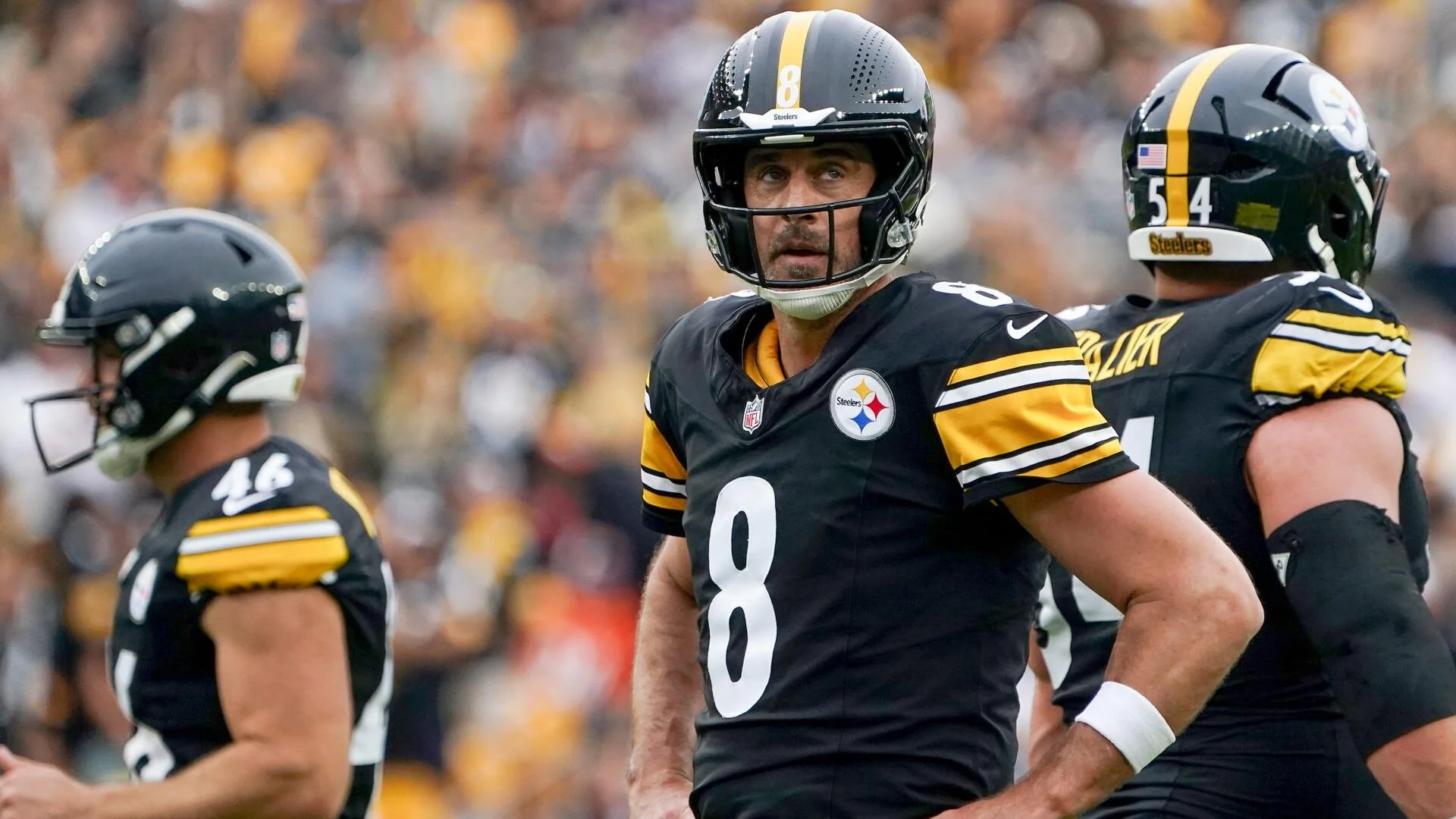
The Pittsburgh Steelers came within minutes of completing a dramatic comeback Thursday night, but a late defensive breakdown and another difficult outing from the offensive line helped turn a potential win into a 27-24 loss to the Cleveland Browns.
Pittsburgh erased an 11-point deficit in the fourth quarter, tying the game at 24 with 1:42 remaining. Cleveland, however, answered with a decisive final possession that ended with Andre Szmyt drilling a 56-yard field goal with 10 seconds left. Aaron Rodgers then threw an interception on Pittsburgh’s final possession, ending the comeback attempt.
Offensive Line Struggles Were a Major Issue
One of Pittsburgh’s biggest problems was protection.
Aaron Rodgers was sacked five times and hit repeatedly as Cleveland’s pass rush created consistent pressure. Despite throwing for 299 yards and three touchdowns, Rodgers was under significant pressure throughout the night.
The lack of protection became especially costly because Pittsburgh frequently had to rely on Rodgers to generate offense rather than consistently controlling the game on the ground.
The Steelers finished with 92 rushing yards, while Rodgers attempted 40 passes.
The Defense Couldn’t Get the Final Stop
After Rodgers completed the comeback and tied the game, Pittsburgh’s defense had an opportunity to give the offense another possession.
Instead, Deshaun Watson moved Cleveland 35 yards on the decisive drive, completing four passes for 45 yards and putting the Browns in position for Szmyt’s game-winning kick.
That sequence ultimately proved decisive.
The Steelers had forced Cleveland into a difficult situation earlier in the game, but when the game was tied late, the defense couldn’t prevent the Browns from reaching field-goal range.
Rodgers’ Two Interceptions Also Mattered
Rodgers had an impressive fourth quarter, but his two interceptions were costly.
His final interception came with just one second remaining, when Grant Delpit picked off a deep pass intended for Roman Wilson. The turnover ended Pittsburgh’s last opportunity to respond.
Rodgers finished 22-of-40 for 299 yards, three touchdowns and two interceptions.
The statistics show both sides of his performance: he helped engineer a dramatic comeback, but the turnovers ultimately contributed to Pittsburgh coming away without a win.
The Joey Porter Jr. Trade Adds Another Layer
The Steelers were also playing their first game since trading cornerback Joey Porter Jr. to the Dallas Cowboys.
Porter had missed Pittsburgh’s first three games amid a contract situation, and his departure left the Steelers without one of their established outside cornerbacks. The trade brought Pittsburgh future draft compensation, but the immediate impact on the secondary was something the team had to manage against Cleveland.
Cleveland ultimately found enough success through the air to set up its final scoring drive.
A Comeback That Fell Just Short
Pittsburgh deserves credit for recovering after falling behind 21-7. Rodgers and the offense produced two fourth-quarter touchdowns, including the late score to Pat Freiermuth that tied the game.
But the comeback wasn’t enough.
The Steelers couldn’t produce the defensive stop they needed, and Rodgers’ final interception closed the door after Cleveland’s game-winning field goal.
Pittsburgh now sits at 2-2, while Cleveland improved to 3-1. The Steelers will return home to face Indianapolis on October 11.
The loss leaves several areas for Pittsburgh to address, particularly offensive-line protection, late-game defense and turnover prevention, before the team continues its season.