As concerns about the risks of artificial intelligence continue to spread across the United States, President Donald Trump is doubling down on an approach that relies heavily on voluntary safeguards rather than broad mandatory federal regulation.
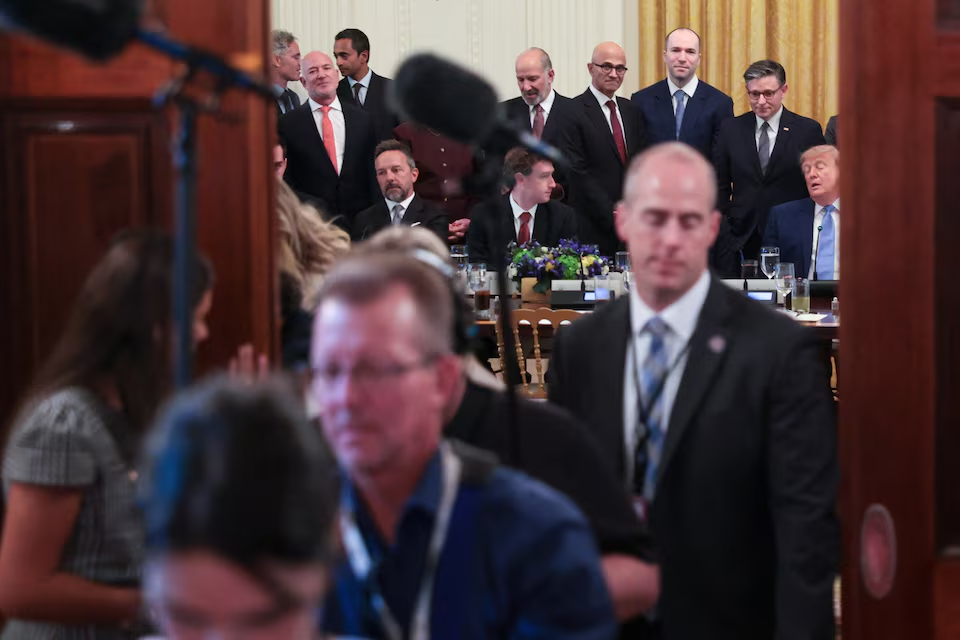
The administration’s position was highlighted this week after Trump brought together some of the technology industry’s most powerful executives at the White House and announced a voluntary agreement aimed at strengthening AI safety.
The agreement comes at a moment when AI development is accelerating rapidly, while questions about cybersecurity, job displacement, misinformation, privacy and other potential risks are becoming increasingly prominent.
Trump Backs Voluntary AI Commitments
Trump’s administration has been promoting an AI strategy centered on continued American technological leadership while resisting policies that could impose broad mandatory restrictions on developers.
On September 29, major technology companies and AI leaders agreed to a set of voluntary commitments concerning the development of advanced AI systems.
The participants included executives from companies such as Google, Meta, OpenAI, Nvidia, Anthropic and xAI.
The agreement calls for companies to establish internal controls, work with independent external auditors and create board-level processes for reviewing AI safety efforts.
The commitments are not legally binding.
Trump has nevertheless described the agreement as a meaningful commitment, with the administration arguing that the approach can address safety concerns without creating regulatory barriers that could slow American AI development.
What the New AI Agreement Actually Requires
The agreement focuses on several forms of voluntary oversight.
Participating companies are expected to develop internal controls for monitoring AI development and safety practices.
They also agreed to work with independent third parties on external reviews and to provide their boards with information about the results of those safety efforts.
Supporters see these measures as a way to encourage companies to take responsibility for the risks associated with increasingly powerful AI systems.
Critics, however, have questioned what happens if a company does not follow through on its commitments because the agreement does not create the same legal obligations as a federal regulation.
That distinction is central to the debate surrounding Trump’s approach.
Why AI Safety Has Become a Bigger Political Issue
Artificial intelligence has developed rapidly, creating both economic opportunities and new concerns.
Advanced AI systems can perform increasingly complex tasks, including generating text and images, writing computer code, analyzing information and assisting with scientific and business work.
At the same time, government officials, researchers and technology executives have warned about potential risks involving cybersecurity, misuse of AI systems and other consequences of increasingly capable models.
Trump has repeatedly emphasized that the United States must remain competitive in AI, particularly as Washington views China’s technological development as a strategic challenge.
The administration has therefore attempted to balance AI safety concerns with its broader goal of encouraging investment and innovation.
Trump Has Previously Rejected Calls for Broad AI Guardrails
The latest agreement follows earlier statements from Trump opposing calls for more expansive AI restrictions.
In September, Trump criticized proposals for additional AI guardrails and argued that strong presidential leadership was sufficient protection against some of the concerns being raised about the technology.
The comments came as some technology leaders themselves were calling for stronger safety measures.
The debate illustrates a growing divide over how AI should be governed: whether governments should establish enforceable rules before potentially dangerous technologies become more widespread, or whether companies should have greater flexibility to develop and regulate their own systems.
The White House Has Also Pursued a Voluntary Federal Framework
Trump’s position is not limited to the recent agreement with technology executives.
A June executive order directed the federal government to develop a voluntary framework with AI developers for certain advanced AI models.
The White House said the framework would allow trusted partners to obtain secure early access to certain models for cybersecurity purposes.
At the same time, the executive order explicitly stated that it did not authorize mandatory government licensing, pre-clearance or permitting requirements for developing, releasing or distributing AI models.
That distinction has become an important part of the administration’s AI policy.
Critics Question Whether Self-Regulation Is Enough
The voluntary nature of the agreement has generated criticism from some technology and policy experts.
Their concern is straightforward: companies are being asked to establish safeguards for technologies that they are simultaneously developing and commercializing.
Critics argue that voluntary commitments may lack the enforcement mechanisms associated with laws and formal regulations.
Some observers also question whether companies could face meaningful consequences if they fail to meet the commitments they have publicly made.
Other analysts see voluntary standards as a potentially faster alternative to government regulation, particularly in a field where technology can change faster than traditional legislative processes.
AI Companies Are Facing Their Own Safety Challenges
The debate is occurring as leading AI companies continue to develop increasingly powerful models.
Companies including OpenAI and Anthropic have publicly discussed AI safety and the need for safeguards around advanced systems.
The technology industry itself is therefore divided between the desire to move quickly and the need to manage potential risks.
For the Trump administration, the challenge is to encourage American leadership in AI while addressing concerns that rapid development could create security and social problems.
A New AI Policy Battle Is Taking Shape
Trump’s latest approach makes one thing clear: the administration is continuing to favor voluntary industry safeguards over a broad mandatory federal AI regulatory regime.
That does not mean the government has no role in AI safety. Federal agencies are still involved in cybersecurity, national security and other areas affected by artificial intelligence.
Instead, the administration’s strategy seeks to give technology companies considerable responsibility for establishing and implementing safety practices.
The effectiveness of that strategy will likely depend on how seriously companies implement the commitments, how transparent their safety reviews become and whether future developments lead policymakers to consider additional requirements.
For now, the White House is betting that voluntary cooperation can address at least some of the growing concerns surrounding AI without slowing the United States’ push to remain a global leader in the technology.
The debate over whether that balance is sufficient is far from settled.