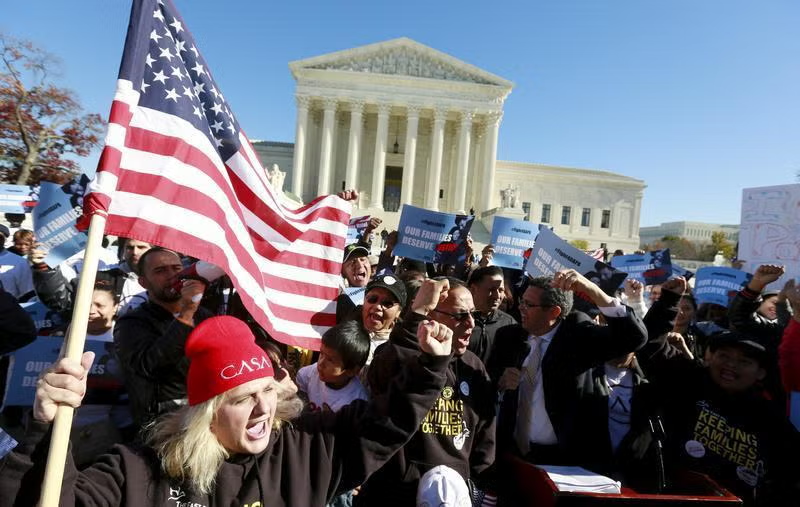
The U.S. Supreme Court is preparing to hear a major immigration case that could determine how the federal government detains certain immigrants while their deportation cases are pending.
The case comes as the Trump administration continues to pursue an aggressive immigration enforcement strategy, while lower federal courts have issued conflicting rulings over how immigration detention laws should be interpreted.
The Supreme Court agreed on October 1, 2026, to hear the dispute, placing the issue among the major immigration questions on the Court’s new term.
What Is the Case About?
At the center of the dispute is the government’s use of mandatory detention for certain immigrants who are facing deportation proceedings.
The Trump administration adopted a new interpretation of federal immigration law in July 2025. Under that interpretation, the government has sought to detain certain people who are already living in the United States while their immigration proceedings continue.
The administration argues that federal law gives immigration authorities the power — and in some circumstances the obligation — to hold these individuals without an individualized bond hearing.
Immigrant advocates and other challengers argue that the policy improperly expands the government’s detention authority.
Why Does the Case Matter?
The Supreme Court’s eventual ruling could affect how immigration authorities handle detention for potentially large numbers of people involved in deportation proceedings.
Reuters reported that the administration’s policy has already resulted in a substantial increase in immigration detention and that hundreds of judges have found the government’s interpretation unlawful.
The central legal question is therefore not simply whether an individual immigrant can be detained.
The broader issue is when the government must provide an opportunity for a judge to consider whether a detained person should be released on bond.
The Dispute Over Bond Hearings
A bond hearing generally allows an immigration judge to consider whether a person should remain detained or can be released while the immigration case proceeds.
Under the administration’s interpretation, certain immigrants covered by the policy can be detained without that type of individualized hearing.
Challengers contend that prolonged detention without such a hearing raises constitutional and statutory concerns.
The government takes a different position, arguing that Congress has given federal immigration authorities broad detention powers for people subject to removal proceedings.
The Supreme Court’s decision will determine how those competing interpretations apply to the relevant category of immigrants.
Lower Courts Have Reached Different Conclusions
The dispute has moved through the federal court system amid disagreements over the administration’s interpretation.
Several federal judges have ruled against the government’s position, while the administration has continued to defend its policy.
That disagreement is one reason the Supreme Court’s involvement is significant.
Rather than allowing the issue to remain divided among lower courts, the justices will now consider the legal questions and establish a nationwide interpretation of the relevant federal immigration law.
A Broader Supreme Court Immigration Agenda
The detention case is not the only major immigration dispute before the Supreme Court during the new term.
The justices are also scheduled to consider a separate case involving the Trump administration’s policy of removing certain immigrants to third countries — countries other than the person’s country of citizenship.
In Department of Homeland Security v. D.V.D., the Supreme Court granted the government’s petition and stayed a lower-court judgment while agreeing to hear the case. The Court’s docket says the justices will consider questions involving jurisdiction, classwide relief and whether the government’s guidance on third-country removals violates federal immigration law or protections under the Due Process Clause and the Convention Against Torture.
That means immigration is expected to be one of the major areas of the Supreme Court’s 2026-27 term.
The Case Comes After Other Major Immigration Rulings
The Supreme Court has already issued significant immigration decisions during 2026.
In June, the justices ruled in Mullin v. Al Otro Lado on when an asylum seeker attempting to enter from Mexico is considered to have “arrived in the United States” under key provisions of the Immigration and Nationality Act.
The decision examined the statutory meaning of arrival and the government’s authority at the U.S.-Mexico border.
The Court’s new term therefore continues a period in which federal immigration authority, detention and deportation procedures have become major constitutional and statutory issues.
What Happens Next?
The Supreme Court’s decision to hear the mandatory-detention dispute does not mean the justices have decided whether the Trump administration’s policy is lawful.
The Court will hear arguments and review the competing interpretations of federal immigration law before issuing its ruling.
The decision is expected to provide guidance to immigration courts, federal agencies and lower courts dealing with detention cases.
For immigrants and families directly affected by detention proceedings, the eventual ruling could have significant consequences.
For the federal government, meanwhile, the case will test the extent of its authority to detain people during deportation proceedings without first providing an individualized bond hearing.
Why This Case Is Being Closely Watched
The Supreme Court’s immigration docket arrives at a particularly important moment for U.S. immigration policy.
The Trump administration has made immigration enforcement a central part of its agenda, while immigrant-rights organizations and several lower courts have challenged various aspects of that approach.
The mandatory-detention case puts one specific question before the nation’s highest court: how much authority does federal immigration law give the government to detain people during deportation proceedings, and when must those individuals receive a bond hearing?
The answer could shape immigration detention policy across the country and become one of the most consequential immigration rulings of the Supreme Court’s new term.