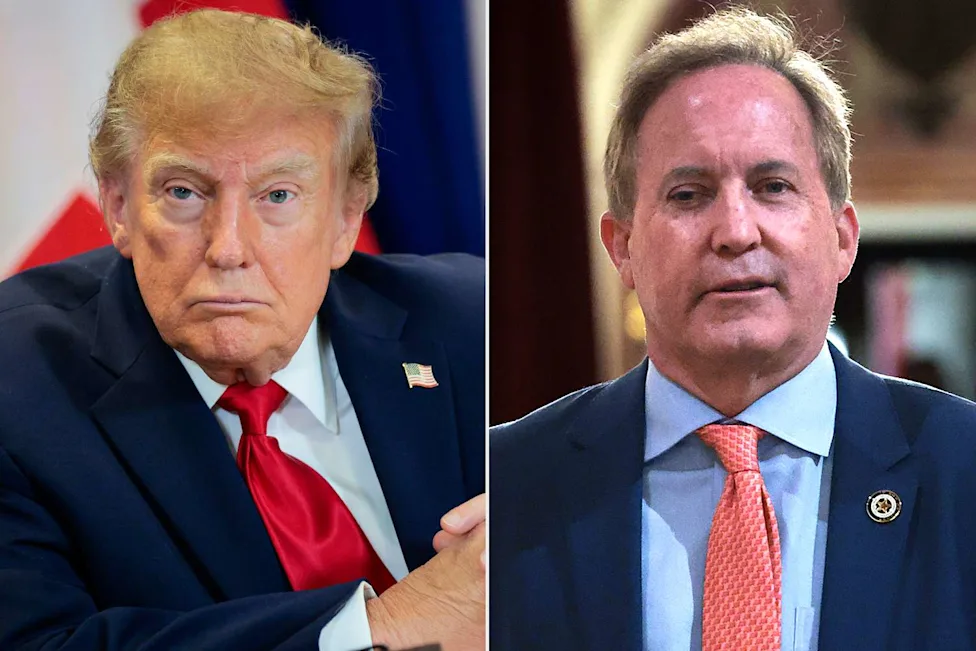
President Donald Trump is pushing back on a leaked recording involving Texas Republican Senate candidate Ken Paxton, after Paxton was reportedly heard telling donors that Republican polling numbers fell following the party’s high-profile midterm convention in Dallas.
The controversy began after The New York Times published audio from a private gathering in which a voice identified as Paxton discussed the impact of the Republican convention on his campaign and other GOP candidates. CBS News said it had not independently verified the recording.
Trump: “I Haven’t Heard That”
Trump was asked about the recording Wednesday and said he had not heard Paxton’s comments.
The president instead defended the Dallas convention, describing it as a major success and pointing to its reported viewership.
Trump said the event attracted roughly 107 million views, comparing that figure with the audience for an NFL broadcast during the same period. He also argued that other Republican candidates benefited from the gathering.
The comments came as questions mounted about whether the convention helped or hurt Republican candidates ahead of the November midterm elections.
What Paxton Was Heard Saying
In the leaked recording, an unidentified person asks Paxton whether “he” was “a little bit of a drag.” The audio does not make completely clear who the question was referring to.
Paxton then discussed the Republican convention and its effect on polling.
According to the recording published by The New York Times, Paxton said the convention had caused “our numbers” to fall and added that “everybody’s numbers dropped.” He described the situation as “not good.”
The convention was held in Dallas earlier in September and featured Trump prominently as Republicans attempted to rally support ahead of the midterms.
Paxton Campaign Disputes the Story
Paxton’s campaign has rejected the characterization of the recording.
His spokesperson, Nick Maddux, described the report as “manipulated nonsense” and argued that it was being used to create a narrative that did not accurately reflect the campaign’s position.
Maddux also pointed to internal polling that the campaign says showed Paxton ahead of Democratic Senate nominee James Talarico by three percentage points.
The competing claims highlight a broader dispute over Paxton’s standing in the race, with different public and internal polling measurements producing different pictures of the contest.
Trump and Paxton Have Remained Political Allies
Trump has been a major supporter of Paxton’s Senate campaign.
Earlier this year, Trump backed Paxton in the Republican primary against incumbent Sen. John Cornyn, helping Paxton secure the GOP nomination after a closely watched primary contest.
Trump later appeared alongside Paxton at the Dallas convention, where he promoted the Texas candidate’s Senate campaign.
Paxton’s private comments therefore stand in contrast to Trump’s public assessment of the event.
Cornyn Reacts to the Leaked Recording
Cornyn, who lost the Republican nomination to Paxton, also responded to the controversy.
Asked about the leaked comments, Cornyn reportedly responded, “whoops!” He later said the Texas Senate race was taking place in a difficult political environment and pointed to the fact that Paxton has not consistently led public polling.
Cornyn also said he did not know what would ultimately happen in the race.
A Closely Watched Texas Senate Contest
The controversy comes as the Texas Senate race attracts national attention.
Paxton is facing Democratic nominee James Talarico, with polling and campaign claims offering differing assessments of the contest. The Texas Tribune reported that Paxton has been trailing in several public polls, while his campaign has cited internal data showing a lead.
Because Texas has long been a Republican stronghold in statewide elections, the race has drawn particular attention from both parties.
What Happens Next?
Trump is scheduled to campaign in Texas, keeping Paxton’s Senate race closely connected to the president’s broader midterm strategy.
For Paxton, the leaked recording creates an unusual contrast between his reported private remarks and the public message coming from Trump and his campaign.
Trump continues to describe the Dallas convention as a success, while the recording attributed to Paxton suggests he believed the event was followed by weaker polling numbers for Republicans.
The disagreement leaves one central question for voters and political observers: how much did the Dallas convention actually affect Republican candidates, and which polling picture will ultimately prove more accurate?
For now, the audio controversy has added another layer to an increasingly closely watched Texas Senate campaign.