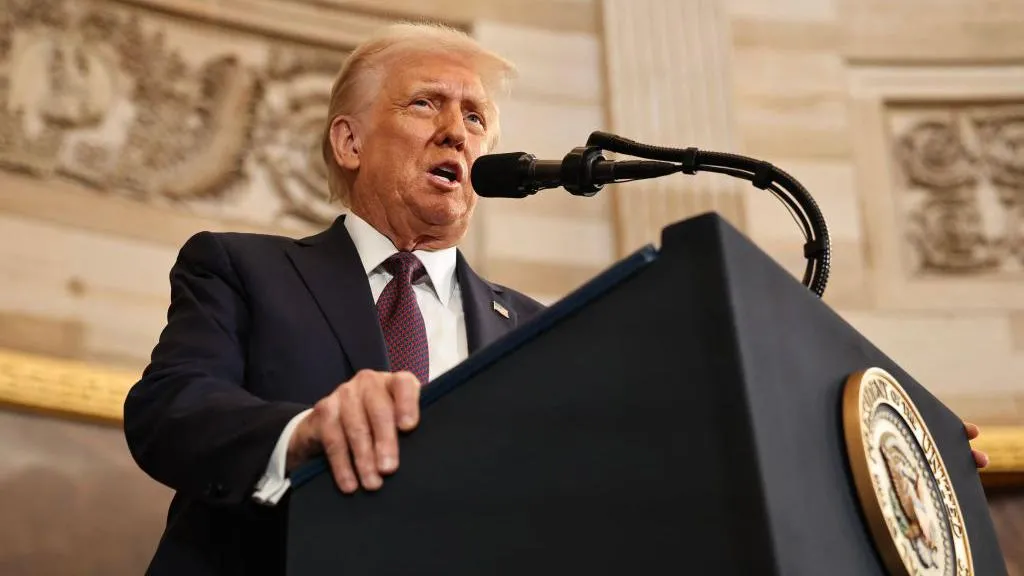
President Donald Trump is calling for Congress to pass a new measure he has named the “No Invasion of Our Country Act,” an effort aimed at making his administration’s strict border policies more difficult for future presidents to reverse.
Trump announced the proposal during his address at the 2026 Republican Midterm Convention in Dallas, arguing that future administrations should not be able to simply change federal border policy through executive action.
“We will pass the No Invasion of Our Country Act,” Trump said during the speech.
The proposal has not yet become law, and detailed legislative text has not been publicly released. That means the exact requirements, enforcement mechanisms and legal limits of the proposed legislation remain unclear.
Trump Wants Border Policies Locked Into Federal Law
Trump’s proposal is based on the argument that major changes in border policy should not depend entirely on presidential executive orders.
During his speech, Trump argued that his administration’s border restrictions should remain in place even if a future president takes a different approach to immigration.
The New York Post reported that Trump described the legislation as an effort to make it legally difficult for a future administration to “open the border again.”
The proposal comes after significant changes in immigration policy between presidential administrations over the past several years.
Why a Federal Law Would Be Different From an Executive Order
Executive orders can be changed or revoked by a subsequent president, although their legal effects can also depend on existing statutes, regulations and court decisions.
A law passed by Congress and signed by the president would create a different legal framework.
A future president generally could not simply erase a federal statute with an executive order. However, Congress could later amend or repeal the law, and courts could be asked to determine whether particular provisions are constitutional or how they should be interpreted.
That distinction is important because Trump’s proposal is currently only an announced legislative initiative rather than an enacted law.
The Proposal’s Details Are Still Unclear
Trump has described the measure in broad terms, but the full legislative language has not been made public.
As a result, it is not yet possible to determine precisely how the legislation would regulate future presidential authority, what specific border policies it would require or how courts would interpret its provisions.
Reports indicate that the proposal could be introduced after the midterm elections, but its timeline and prospects in Congress remain uncertain.
The legislation would also need to pass both chambers of Congress and be signed into law before it could take effect.
Border Security Has Become a Central Political Issue
Trump’s proposal comes as immigration and border security remain major issues in the 2026 midterm campaign.
During his Dallas speech, Trump criticized the immigration policies of the previous administration and highlighted his administration’s current enforcement approach.
He also pointed to reductions in migrant encounters and other border statistics while arguing that his policies had significantly changed conditions at the southern border.
Those claims are part of Trump’s broader political argument for maintaining his administration’s immigration policies.
Debate Over Immigration Enforcement
The proposal is likely to generate continued debate over the balance between federal border enforcement, presidential authority and immigration rights.
Supporters of stricter enforcement argue that federal immigration laws should be consistently enforced and that future administrations should not be able to substantially change border policy without congressional action.
Critics of Trump’s immigration approach have raised concerns about due process, asylum access and the treatment of migrants.
Those disagreements are likely to become part of the broader congressional debate if formal legislation is introduced.
Could the Constitution Be Changed?
Trump’s public proposal specifically concerns legislation. It is not currently a constitutional amendment.
Changing the Constitution would require a substantially different process under Article V, including approval by two-thirds of both the House and Senate and ratification by three-fourths of the states, or an alternative constitutional convention process followed by ratification.
Therefore, a federal statute and a constitutional amendment should not be treated as the same thing.
A statute could establish federal requirements while remaining subject to future congressional amendment, judicial review and constitutional limitations.
What Happens Next?
The next major step will be the release and introduction of actual legislative language.
Once a bill is formally introduced, lawmakers and the public will be able to examine its specific provisions, including how it would affect presidential authority, border enforcement and immigration procedures.
Congress would then have to determine whether to advance the measure.
For now, Trump’s “No Invasion of Our Country Act” remains a proposal rather than enacted law. Its ultimate impact will depend on the legislation Congress considers, the votes it receives and any constitutional challenges that could follow.
The proposal nevertheless signals that border enforcement will remain a major issue as the United States approaches the 2026 midterm elections.